Brain games give older adults a reason to sit down with a pencil, chat with a friend and enjoy a small win. They are also cheap and easy to set up at home or in a senior center. Here are the games that work best, how to choose the right level, and how to run them with a group.
Word games
- Word search: a gentle start, because the words are listed and there is no wrong answer. Try the large print travel word search.
- Crosswords: they draw on general knowledge and a lifetime of vocabulary. Work one together and read the clues aloud.
- Word scrambles: short and quick, so they suit a coffee break or a tired afternoon.
- Word ladders: change one letter at a time to reach a new word. A nice step up once word searches feel easy.
- Cryptograms: crack a letter code to reveal a saying. These suit people who like a real challenge.
For more ideas and group rules, see word games for seniors.
Number and logic games
- Sudoku: no math needed, only careful checking. Start with small grids, then move on to our printable sudoku puzzles.
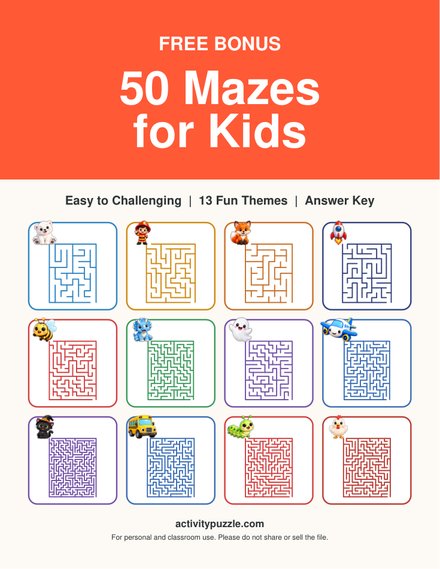
- Mazes: calm, quiet and satisfying. Try the large print maze set.
- Card and dice games: rummy, dominoes or Yahtzee add a social side to the counting.
Memory and conversation games
- Finish the phrase: read the start of a well-known saying and let the group finish it.
- Name ten: ten kinds of tree, ten songs, ten ways to use a spoon. There are no losers.
- Trivia: questions about old movies and music bring out stories. Try our trivia for seniors.
How to choose the right level
- Pick print that is comfortable to read. Large print helps almost everyone in a group.
- Start one level easier than you think. A puzzle finished feels better than a puzzle abandoned.
- Offer a choice of two puzzles, so that it stays an invitation and not a test.
- Keep sessions short, about 15 to 30 minutes, and stop while people are still enjoying it.
Running a group session
- Print the sheets at 100% and use a thick, soft pencil or a felt pen.
- Work in pairs, so that someone with weaker eyesight can still join in by calling out answers.
- Keep the answer pages with you and reveal them at the end.
- Praise effort and funny guesses rather than speed.
Questions families and activity staff ask
Do brain games prevent memory loss?
We cannot promise that, and nobody should. Enjoyment, routine and time with other people are good reasons to play on their own. For health questions, please talk to a doctor.
Which game is best for a beginner?
A word search. It is easy to explain, and a large print sheet can be finished in a few minutes.
Are these games suitable for people with dementia?
Some people enjoy simple word searches or coloring, while others find them frustrating. Follow the person, keep it relaxed and stop if it stops being fun.
Browse everything in large print puzzles for seniors and printable puzzles for adults.